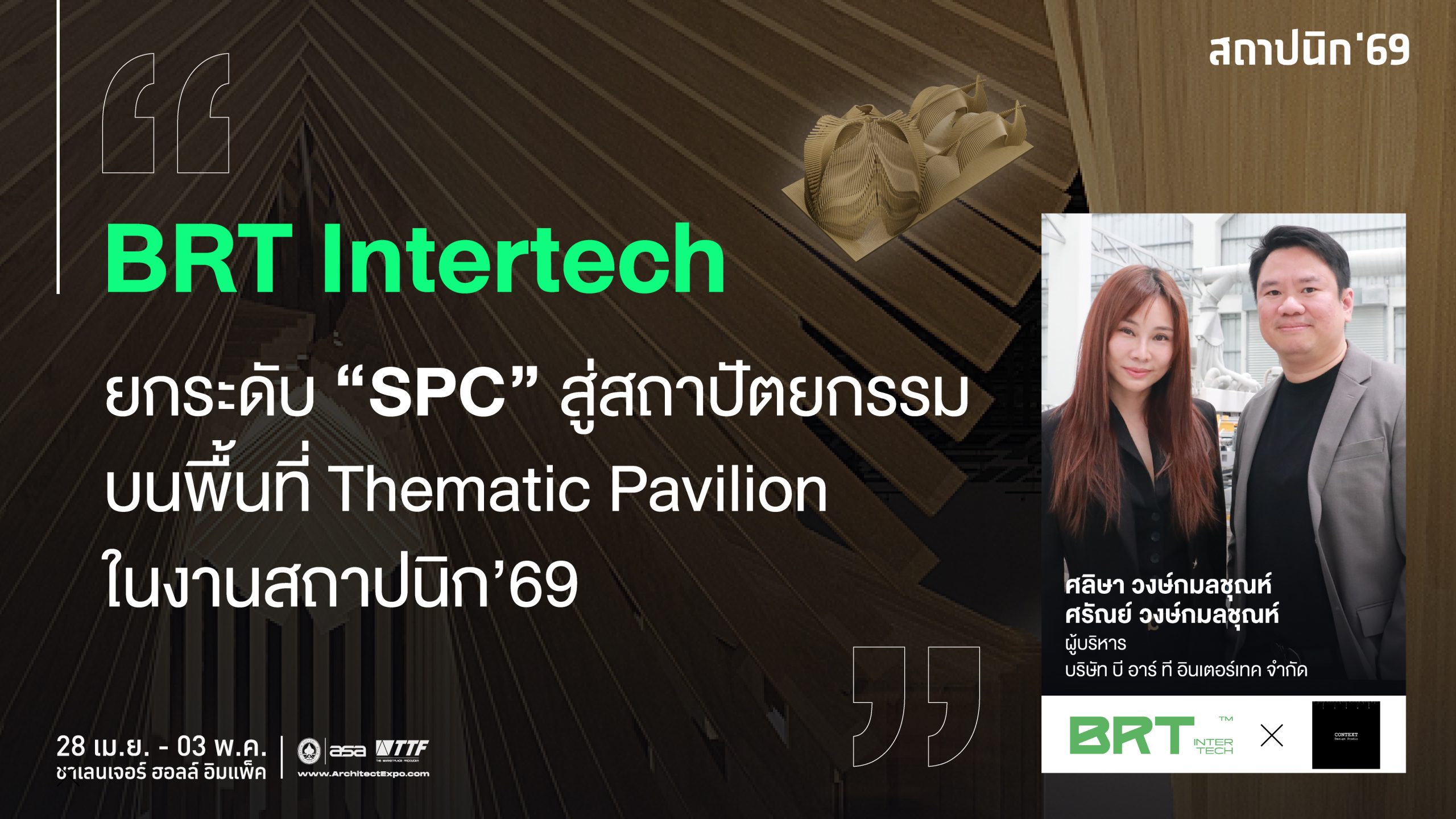
What many know simply as “ready-made flooring” is about to be seen in an entirely new light. BRT Intertech, owner of the INTO SPEC and SMARTMATT brands, is inviting the industry to look at SPC differently — not merely as a material that answers basic functional needs, but as one capable of transcending its original limitations to become a fully realized component of architectural work.
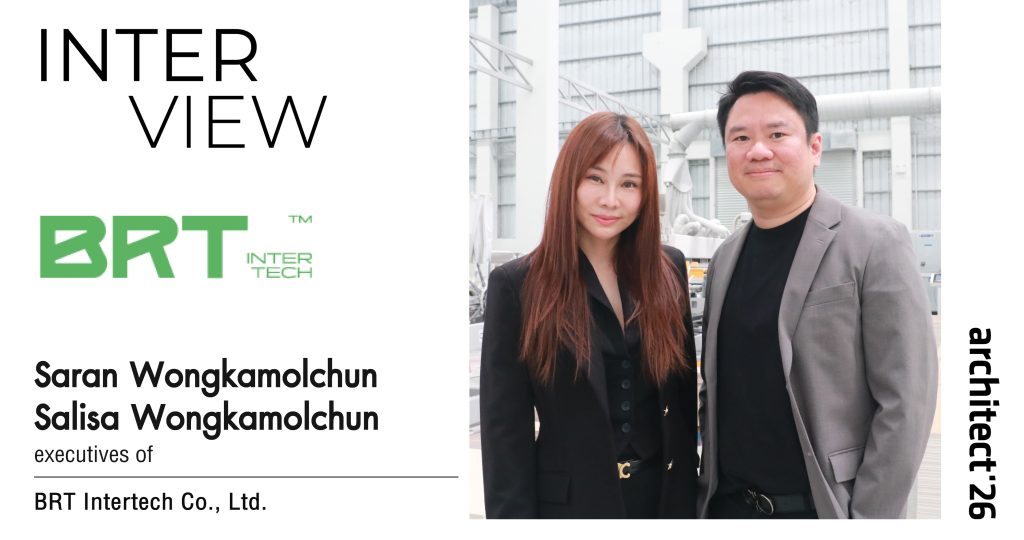
Mr. Saran Wongkamolchun and Ms. Salisa Wongkamolchun, executives of BRT Intertech Co., Ltd., reveal that the brand’s participation in Architect’26 is driven by a deliberate intent to shift its own role — from being a material manufacturer and distributor, toward becoming a more active participant in the design process itself.
The goal is not simply to present products for consumers to choose from. It is to help visitors — especially architects and designers — see the potential of SPC across a far wider dimension: from a material once confined to flooring or ready-made surface applications, to one capable of creating spaces, building structures, and genuinely functioning as architecture.
Choosing the Thematic Pavilion format is therefore not merely a change of booth style — it is a change in how the brand communicates, elevating its image from a retail product to an Architectural Material, and repositioning itself as a Material Partner ready to collaborate with designers at every stage of a project.
When “SPC” Is No Longer Just a Floor
BRT Intertech specializes in wood substitute materials — particularly SPC (Stone Plastic Composite), which offers outstanding dimensional stability, waterproofing, termite resistance, weather durability, and a surface feel close to natural wood.
But for the brand, what matters most is not the material’s properties in isolation — it is changing the way the entire market perceives the material.
Where SPC has traditionally been categorized as a flooring product or a retail item, the brand is now actively pushing for that same material to be recognized as an Architectural Material — applicable to walls, staircases, ceilings, and complex architectural elements.
“We want people to stop thinking of SPC as just a floor. We want them to see it as a material that can design far more than that.”
This vision is not simply about expanding the material’s range of applications — it is about expanding the brand’s own role, from product manufacturer to Material Partner capable of working alongside designers to develop new solutions and advance the possibilities of architectural work together.
When Material Becomes Real Architecture: The Thematic Pavilion
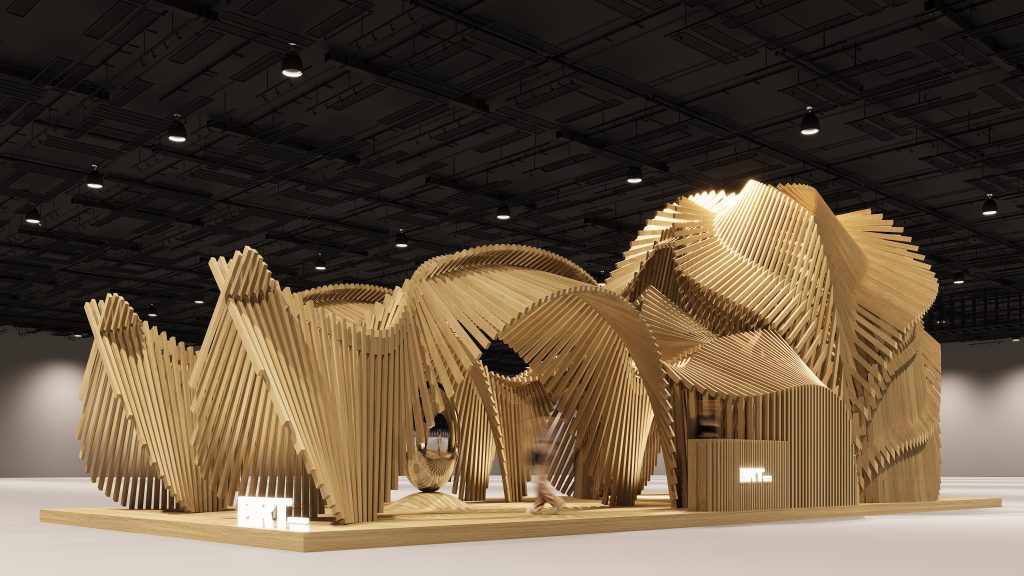
BRT Intertech’s entry into the Thematic Pavilion format this year represents a pivotal step in elevating SPC’s role — from product to demonstrated architectural potential — in a space that visitors can walk through, touch, and experience for themselves.
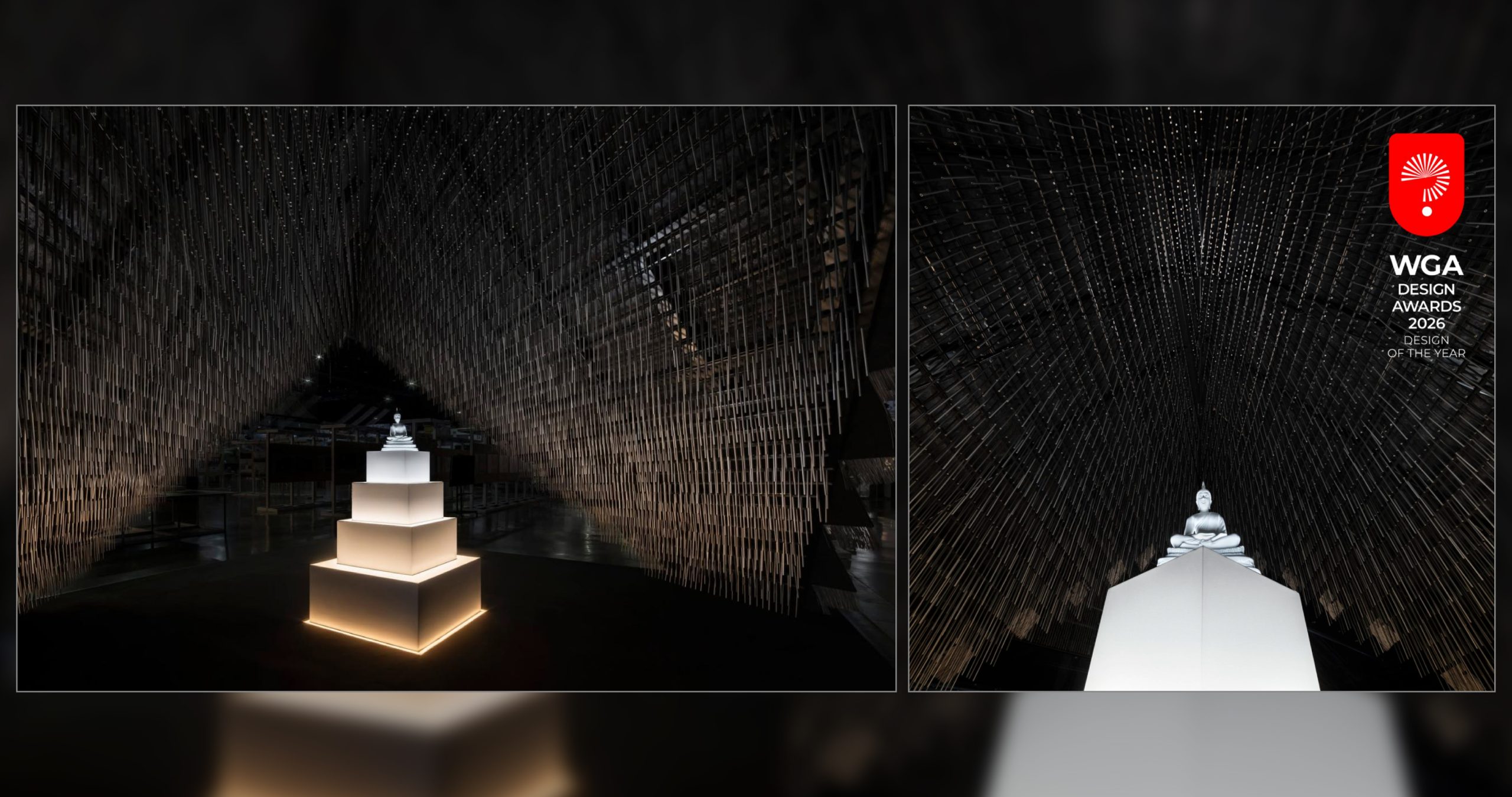
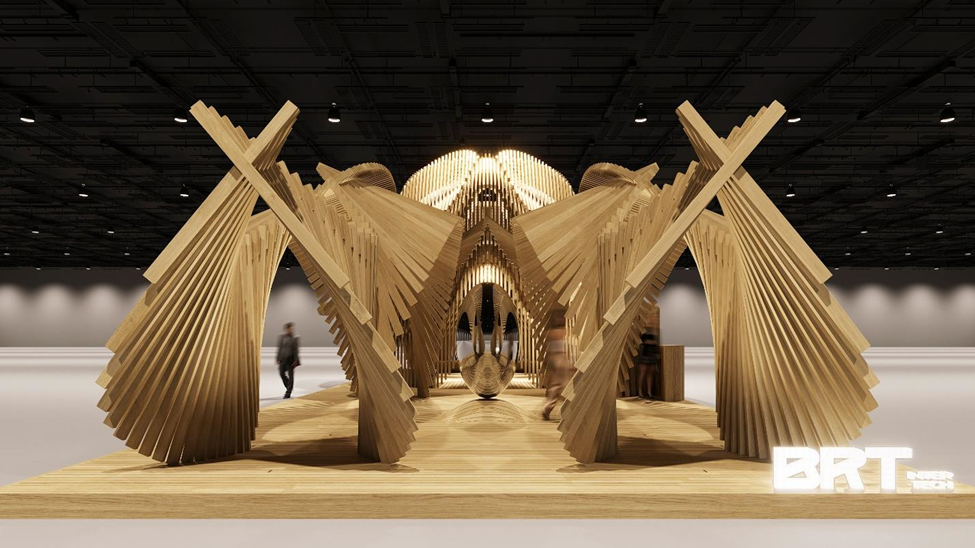
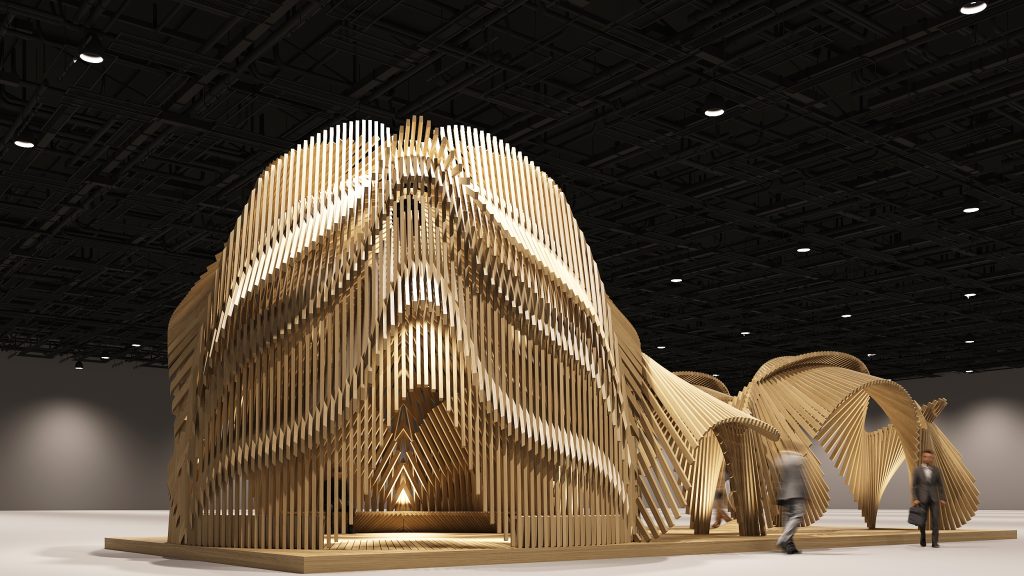
The pavilion “Pranasathan (SATI)” was designed by Khun Ton — Bodin Phlangkur of Context Studio, fusing the concept of “mindfulness” and heightened perception with contemporary design processes, and incorporating technology as an integral part of shaping form and space.
From the brand’s perspective, its own role in this project was to provide material property data and open the door for the design team to take it further — while the architects interpreted the concept and developed it into a parametric design of considerable formal and structural complexity.
What emerged is a clear demonstration: when SPC is placed within the context of real design, the way visitors perceive it transforms — from seeing it as a mere “material panel” to understanding that the same material can become a structure capable of delivering a complete architectural experience.
When Material Limitations Become the Starting Point of Design
While SPC’s strengths in rigidity, stability, and environmental durability are well established, it also carries a clear limitation as a “flat panel material” — one typically applied in planar configurations.
The central design challenge of “Pranasathan (SATI)” was therefore not simply to use the material — but to ask how a flat panel material can transcend its original constraints and evolve into dimensional architecture.
Working in collaboration with the design team, SPC panels were arranged, positioned, and individually angled with precision — giving rise to curved structures, tunnel-like passages, and spaces with a distinct rhythm of light and shadow. A material once associated purely with flat planes became a dynamic element capable of creating genuine spatial experience.
For the brand, this collaborative process opened an entirely new perspective on a familiar material.
“The same material — when the perspective changes, the outcome changes immediately.”
And it is precisely this realization that led BRT Intertech to see clearly: the limitations of a material are not the end of the road — they are the beginning of new design possibilities.
From Collaboration to a New Direction in Material Development
One of the most significant outcomes of participating in the Thematic Pavilion is that BRT Intertech has discovered new potential within the materials it develops.
Where product development once focused primarily on durability and fundamental function, the brand is now expanding its outlook toward supporting increasingly complex design applications — in terms of form, installation systems, and diverse architectural use cases.
At the same time, the experience of collaborating with designers has opened new opportunities in the project market — from hospitality work and custom commissions to specialized projects that demand materials with a far greater degree of design flexibility than before.
In this light, BRT Intertech no longer views materials as products developed purely for end use — but as components of a design process that can be developed and extended in long-term partnership with designers and creators.
This thinking is precisely what has led the brand to position itself as a “partner” — ready to think together, develop together, and push new possibilities forward alongside designers and users alike.
When Materials Go Further Than Ever Before
In BRT Intertech’s view, the future of construction materials does not stop at being a product. Materials must be capable of answering demands across usability, sustainability, and an increasingly open landscape of design possibility.
SPC as a wood substitute not only helps reduce the consumption of natural resources — it is a material that can be extended into increasingly diverse and complex design applications, ready to meet the needs of architecture in new contexts.
More important still is helping people “understand materials” across a wider dimension — not merely as something to be selected and applied, but as something that can be used to create, and to ask new questions of design.
For BRT Intertech, the success of “Pranasathan (SATI)” does not lie in the form or scale of the structure alone — it lies in prompting visitors to begin questioning the familiar: how far can the SPC panel in front of me actually go?
And when that question arises — that is the beginning of seeing materials in a new way.
“The materials we use every day — can they actually go further than we think?”
Because when materials go further, design no longer needs to stay where it was.
And in the end, every great project often begins with
“the material that makes it possible.”
Come and find the answer for yourself at the BRT Intertech Pavilion Booth TP07 — Architect’26—the 38th THE ASEAN’S LARGEST BUILDING TECHNOLOGY EXPOSITION taking place from April 28 – May 3, 2026, from 10:00 AM – 8:00 PM at IMPACT Challenger Hall 1–3, Muang Thong Thani.