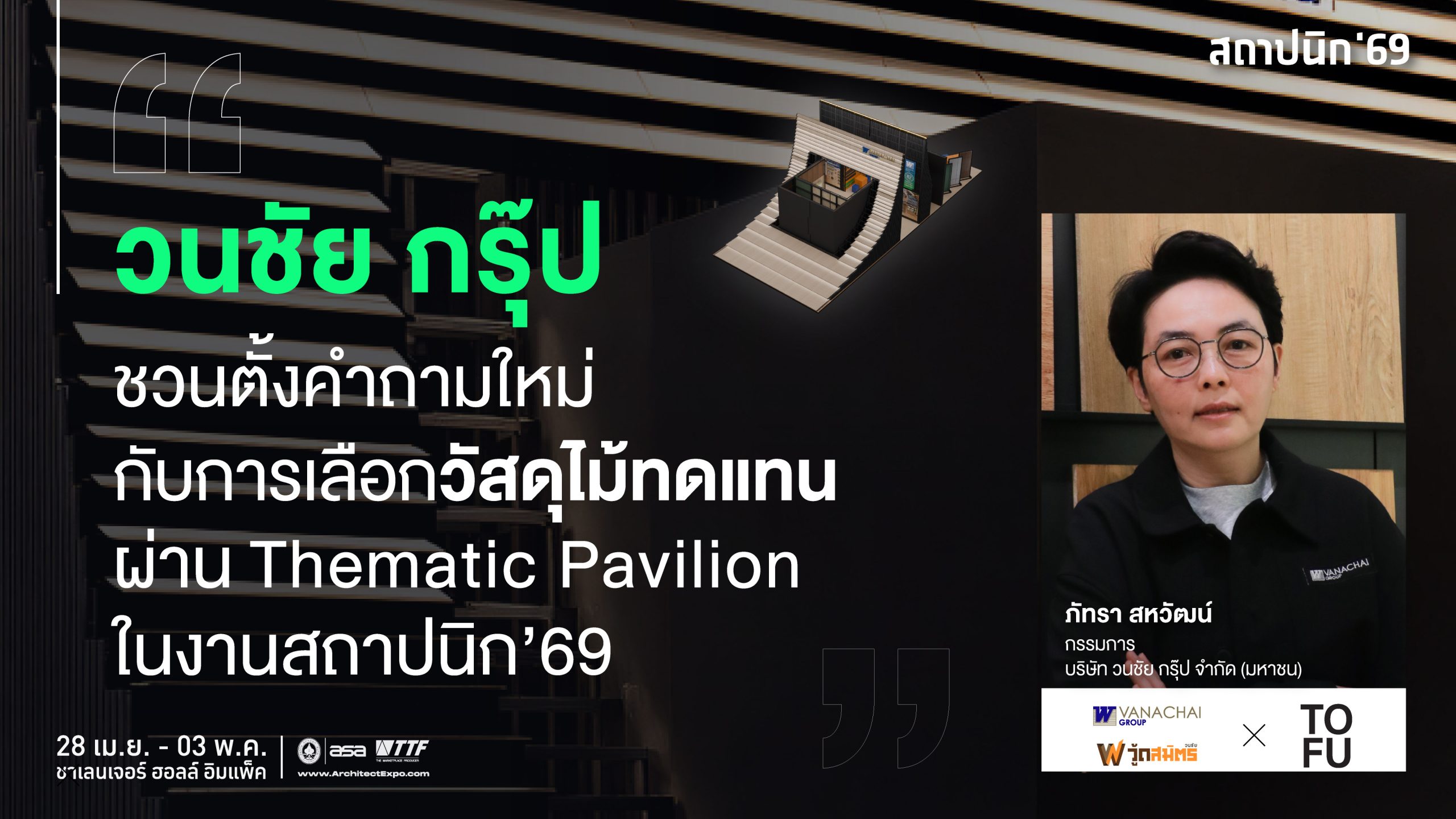
From the origins of a sawmill to becoming one of Thailand’s pioneers in the wood substitute industry, Vanachai Group is today inviting everyone to look at the familiar material of “wood” with far greater depth than before — not merely as a material for furniture or construction, but as the outcome of a thinking process that connects upstream resource management all the way through to environmental impact and the health of end users.
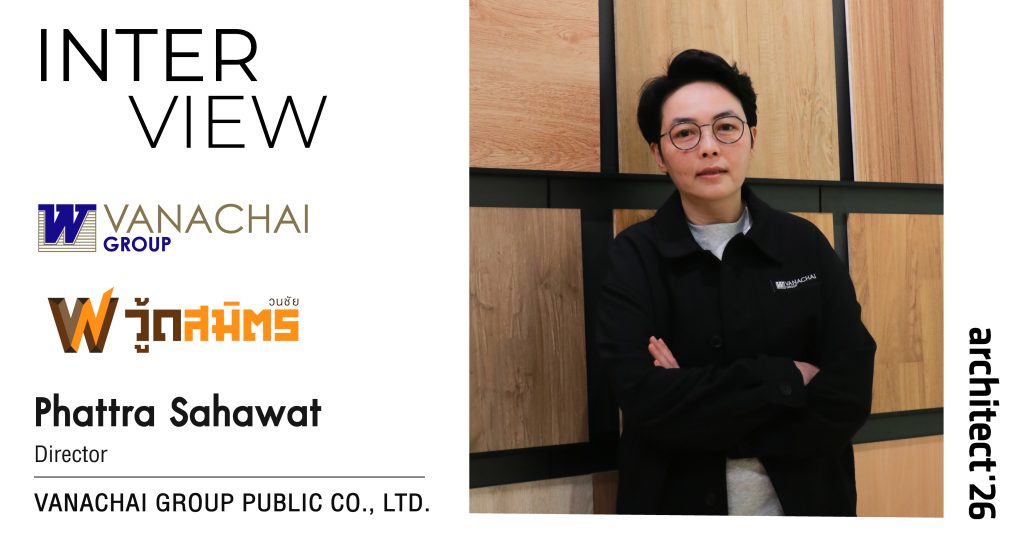
Ms. Phattra Sahawat, Director of Vanachai Group Public Company Limited, shares that across more than 80 years of the organization’s history, the most significant transformation has not been a business one — it has been a transformation in “the way we think about materials.”
The moment natural wood began to decline in availability became the turning point that led Wanchai to develop “wood substitutes” from end-of-productive-life rubber trees — a material that was once simply burned and discarded, converted into the new raw material of an industry.
From “Waste” to the Starting Point of an Industrial Material System
What sets Vanachai apart is not only the type of products it offers, but “the way it sees resources” — from the very beginning.
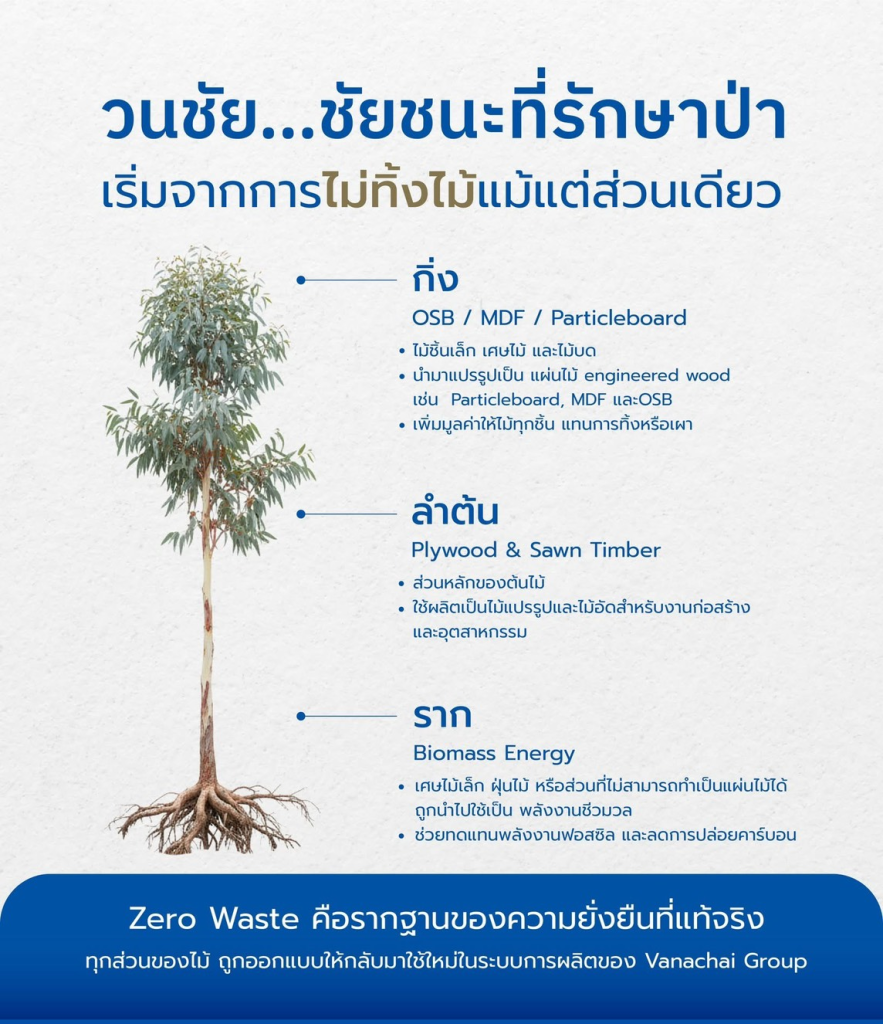
Rubber trees that have reached the end of their latex-producing life — once a burden for farmers and routinely disposed of by burning — are brought back into the production process by Wanchai, transforming discarded material into the foundational raw material of an industry. Through processing into Particle Board, MDF, and OSB, the approach extends further into a production system that utilizes every part of each tree: roots are directed into energy generation, and wood dust is cycled back into the manufacturing process.
“In our production line, there is virtually no waste.”
This is not merely a description of a process — it reflects the organization’s core philosophy: that “every part of a resource holds value” when used within the right system.
This thinking extends to the factory structure itself, through the use of Biomass and Solar Roof energy as primary power sources — reflecting an industry direction that looks beyond the end product, and considers environmental impact at every stage, systematically and continuously.
Thematic Pavilion: A Space That Tells the Story of Thai Industry’s Potential
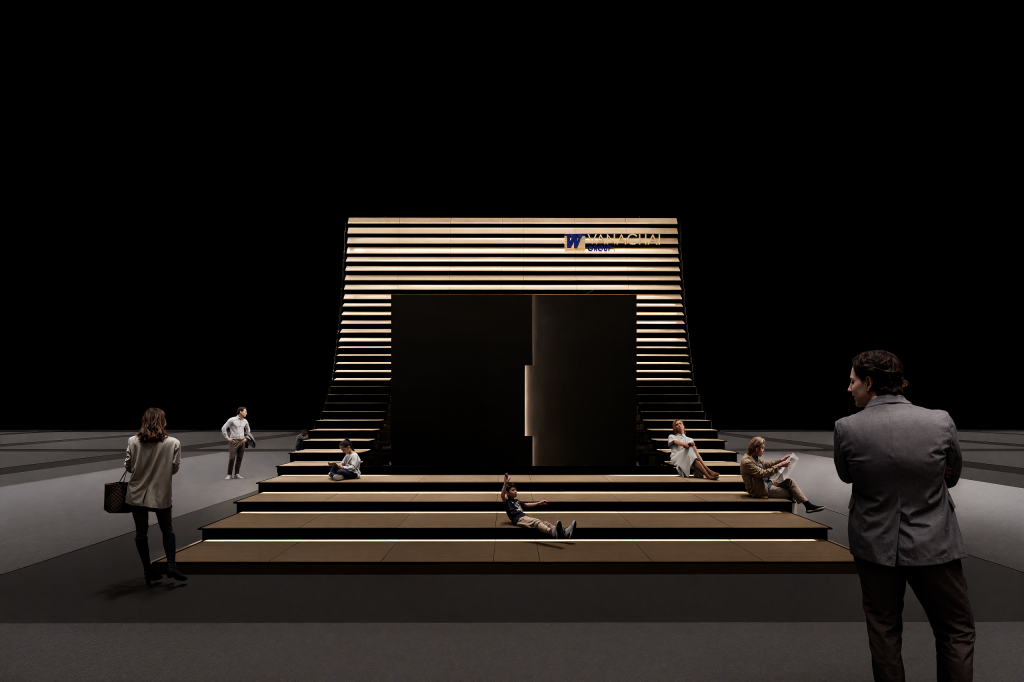
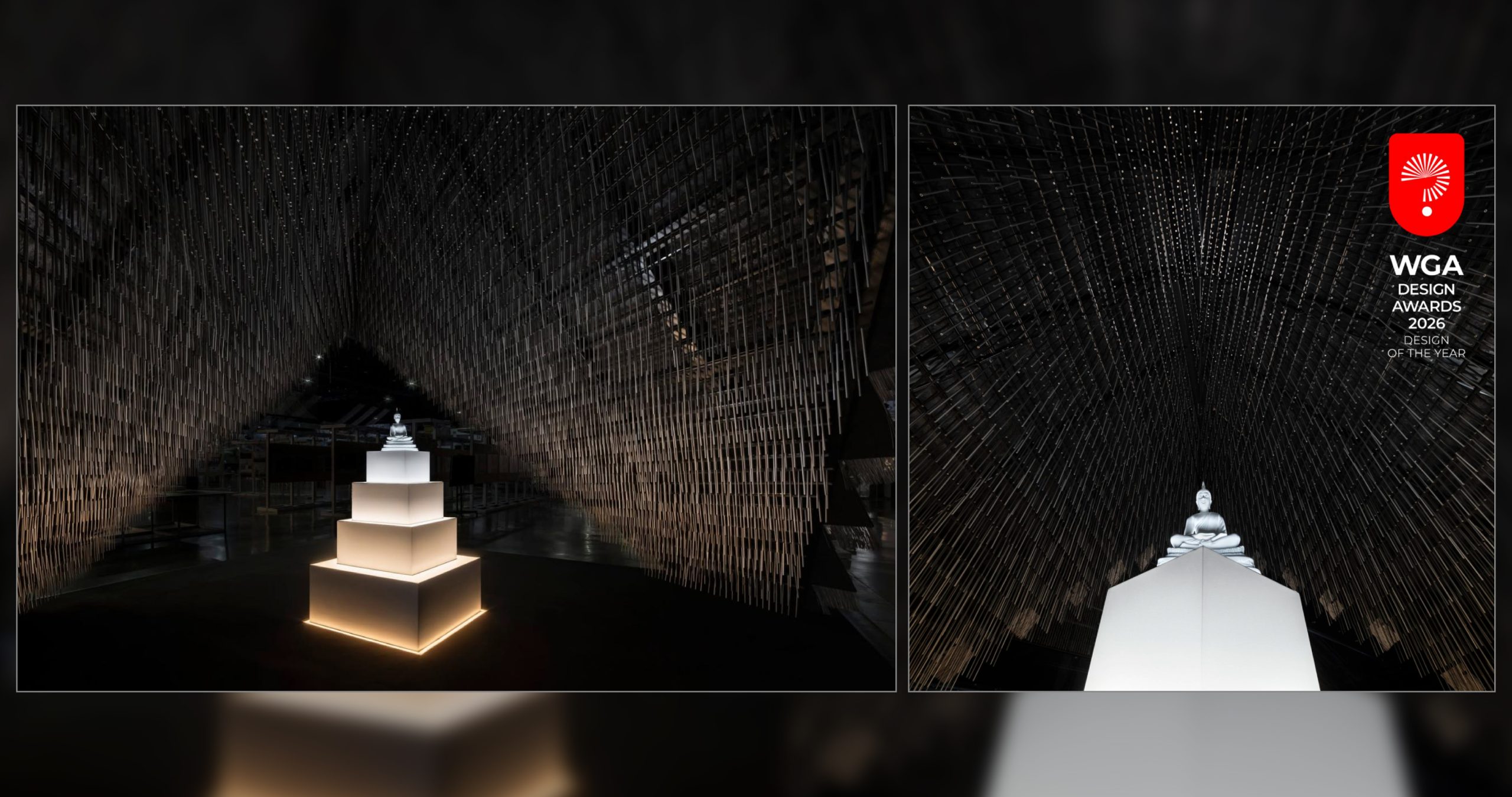
Returning to the Thematic Pavilion for the second consecutive year at Architect’26, Wanchai’s participation is not simply a continuation of past experience — it is a deliberate shift in role: from material manufacturer to a more serious communicator of the industry’s broader picture.
Because most of Wanchai’s products are not finished goods in the conventional sense — they are materials that work behind the scenes in design and construction — the challenge is not simply to present products, but to help “general audiences understand” where these materials come from, what thinking systems underpin them, and how they affect everyday life.
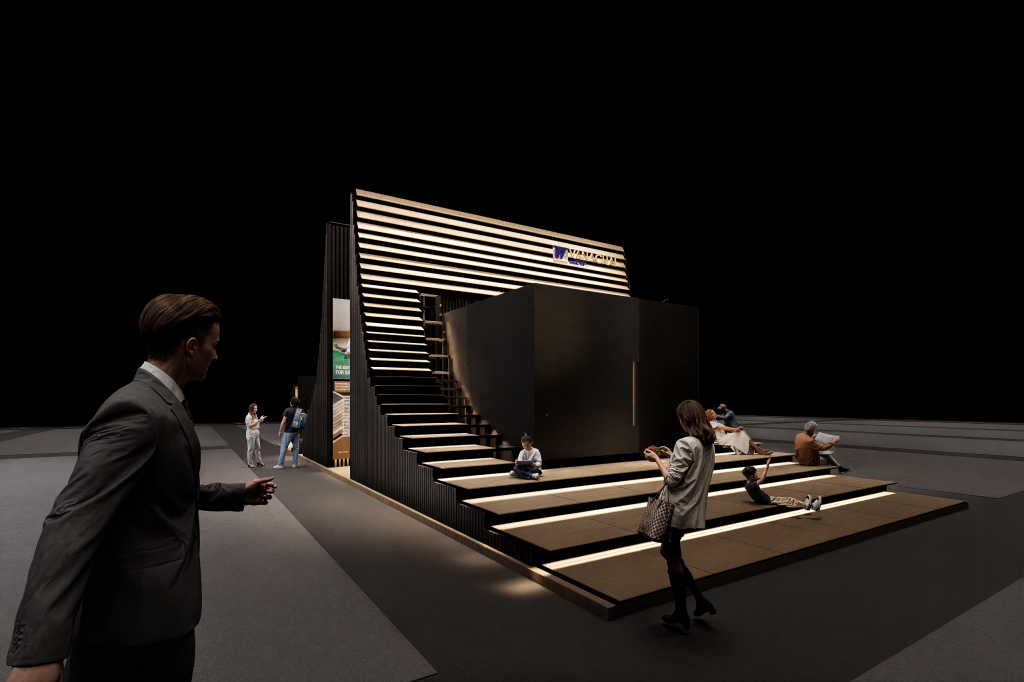
This year’s pavilion is therefore designed to function as a “storytelling space” — connecting the upstream and downstream of the industry: from the origin of raw materials and production processes, through to the environmental and health dimensions affecting end users.
At the same time, the collaboration with Studio Tofu as the design team is a key element that opens fresh perspectives on the materials — interpreting the potential of wood substitute panels in an architectural context, and developing that interpretation into a spatial experience that visitors can enter, feel, and perceive directly.
When those perspectives are expressed through architecture, the Thematic Pavilion becomes a crucial bridge — allowing materials that once existed entirely behind the scenes to step forward and communicate with people in an entirely new dimension.
From Manufacturer to “Knowledge Communicator” for the Industry
Another role Wanchai has been working to clarify in recent times is the move from being a material producer to becoming a genuine “knowledge communicator” for the industry and its users.
In reality, many construction materials used in daily life carry important details that most users have never been made aware of — from material types and production processes, to the chemical compounds concealed within them — all of which directly affect both functional performance and long-term quality of life.
The issue of formaldehyde in particular is invisible to the naked eye and frequently overlooked, yet it carries a direct and significant impact on the health of building occupants over the long term.
“Materials that look nearly identical on the outside can produce completely different outcomes.”
This observation is not merely an aside — it reflects a fundamental gap in understanding within the construction materials market that continues to require clear and ongoing communication.
For this reason, Wanchai has chosen to use the Thematic Pavilion as more than an exhibition space — it is a “space for reflection” that invites visitors to question what is closest to them, so that future material choices are not based purely on image or familiarity, but on genuine understanding of how what we bring into our homes affects our lives over the long term.
When Materials Inside the Home “Affect More Than We Can See”
Another concern Wanchai has been addressing with increasing clarity is the need to expand the lens through which construction materials are viewed — from things that answer structural or aesthetic needs, to things that directly affect the quality of life of the people who use them.
In the past, material selection was guided primarily by strength, price, or appearance. Today, those factors alone may no longer be sufficient, as people increasingly recognize that what is present inside their homes — even invisibly — can affect their health over the long term.
Whether volatile compounds in the air, accumulated odors, or chemical components slowly released by materials over time — all are directly linked to the experience of living, particularly in an era where “home” has become the space in which we spend most of our time.
This thinking led Wanchai to seriously pursue the development of Non-Formaldehyde products, across both panel materials and related products — reducing the release of health-affecting substances and raising material standards in alignment with modern living principles.
This direction is also connected to the ESG framework the organization has consistently prioritized — not only in the environmental dimension, but in the “people” dimension as well: the end users who ultimately live alongside these materials every day. Because in the end, a good material may not be measured by durability or service life alone — but by whether it can coexist with human life safely over the long term.
“Are the Materials You Use Every Day Actually Safe?”
For Wanchai, what it hopes to achieve through this year’s pavilion is not simply a visit — it is an invitation for everyone to “ask questions” about what is closest to them.
The materials we use in our homes every day may look nearly identical on the surface — but what lies within, from production processes and standards to concealed chemical compounds, can be entirely different. Volatile substances in particular cannot be seen with the naked eye, yet they directly affect health over the long term.
“Some things we cannot see — but our bodies take them in every single day.”
Vanachai therefore does not simply want visitors to “understand materials” — it wants to prompt everyone to go back and ask questions about the spaces they actually inhabit: how safe are the materials we choose for ourselves, and for the people we share our homes with?
Come and start asking questions for yourself at the Vanachai Group Pavilion Booth TP02 — Architect’26—the 38th THE ASEAN’S LARGEST BUILDING TECHNOLOGY EXPOSITION taking place from April 28 – May 3, 2026, from 10:00 AM – 8:00 PM at IMPACT Challenger Hall 1–3, Muang Thong Thani.