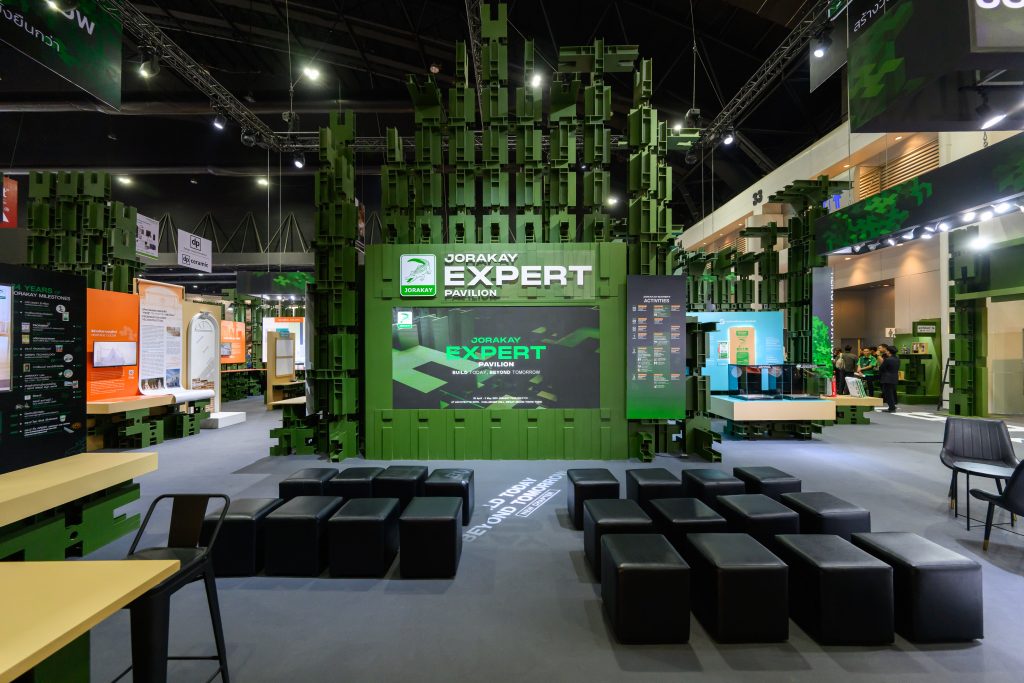
For exhibitions, it is common to invest significant resources in creating beautiful exhibition spaces that attract visitors and present a brand at its best—all for just a few days before everything is dismantled and ends up as a “large pile of waste” once the event is over.
For Jorakay Corporation, however, the important question is not simply how beautiful a booth can be or how effectively it can communicate the brand. It is also about asking:
“How can this pavilion continue to live after the exhibition ends?”
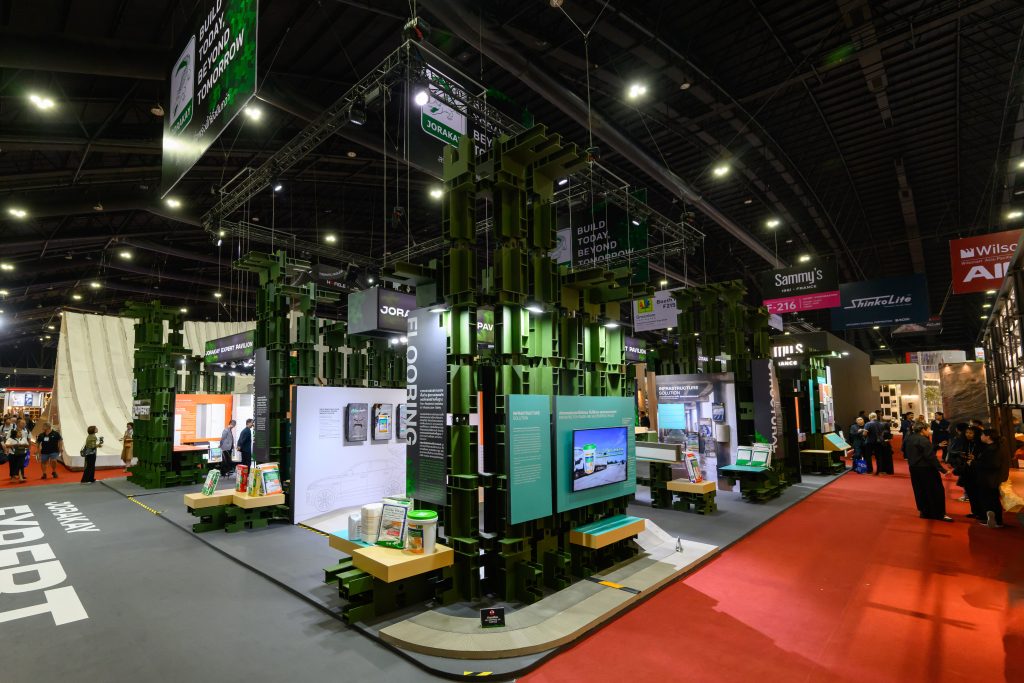
This question became the starting point for Jorakay’s pavilion at Architect’26, which received a Silver Award from the ASA Green Pavilion Awards under the ASA100 Sustainable Goal initiative. The pavilion was designed to minimize waste from the outset, use materials meaningfully, and ensure that every component could be dismantled, transformed, and genuinely reused after the event.
Behind the pavilion was more than an attempt to create a booth aligned with the principles of sustainability. It was an opportunity to translate the way Jorakay has continuously approached its business into a tangible exhibition space.
Beyond Pain Point: Where Innovation Begins by Thinking Beyond the Problem

Dr. Jirat Sirichalermpong, CEO of Jorakay Corporation Company Limited, explains that Jorakay has grown as a provider of integrated construction, repair, and finishing innovations. A key part of its approach is to identify problems experienced by real users—whether homeowners, contractors, engineers, designers, or property developers—and turn those pain points into solutions that go beyond the original problem.
“We don’t just address the pain point. We try to go beyond the pain point.”
One example that clearly reflects this approach is Jorakay’s cement adhesive product range, in which the company is already one of the market leaders. As PM2.5 and construction dust have become increasingly important issues, the company recognized that construction materials themselves are part of the source of the problem and therefore have a responsibility to address it.
Jorakay developed Dustless Technology to reduce the dispersion of dust during use, achieving up to an 80% reduction in dust dispersion. The benefits extend beyond end users to everyone throughout the process—from factory employees and retailers to contractors and people living near construction sites.
This reflects Jorakay’s broader approach to sustainability. Rather than treating sustainability simply as a CSR (Corporate Social Responsibility) activity or a short-term marketing campaign, the company sees it as a system of thinking that connects products, production processes, people, the environment, and society.
When Sustainability Is Not Just in the Product, but in Every Process
Dr. Jirat explains that Jorakay’s sustainability framework is built around three key areas: Jorakay Green Process, Jorakay Green Planet, and Jorakay Green People.
Green Process means considering sustainability from research and development through production and product delivery.
Green Planet focuses on minimizing environmental impact throughout every process.
And Green People focuses on developing people—including employees, professional users, young people, and communities surrounding the factory—to build greater awareness of sustainability and the circular economy.
One clear example is Green Pack, a packaging solution that reduces plastic usage and cuts carbon dioxide emissions by 49% compared with the previous packaging. But Jorakay did not stop at reducing the environmental impact of its own operations. The company redirected the resulting cost savings into a fund, supplemented it with additional contributions, and used the funds to support mangrove forest restoration in collaboration with the Department of Marine and Coastal Resources.
The project covers more than 60 rai and will be maintained continuously for 10 years, with local communities employed and involved in its ongoing care.
For Jorakay, this represents a holistic approach to sustainability. It is not only about reducing what causes harm, but also about creating something new and giving back in return.
A Pavilion That Began with One Principle: “It Must Not End with the Exhibition”
When it came to designing the pavilion for Architect’26, Jorakay gave the design team a clear brief: the exhibition space had to reflect the brand’s commitment to sustainability, the circular economy, and the concept of “Build Today Beyond Tomorrow.”
For this project, Jorakay collaborated with Integrated Field (IF) for the first time. Rather than beginning with a predetermined booth format, the process started with communicating who Jorakay is, what the company cares about, and how the pavilion could continue to have meaning after the event ended.
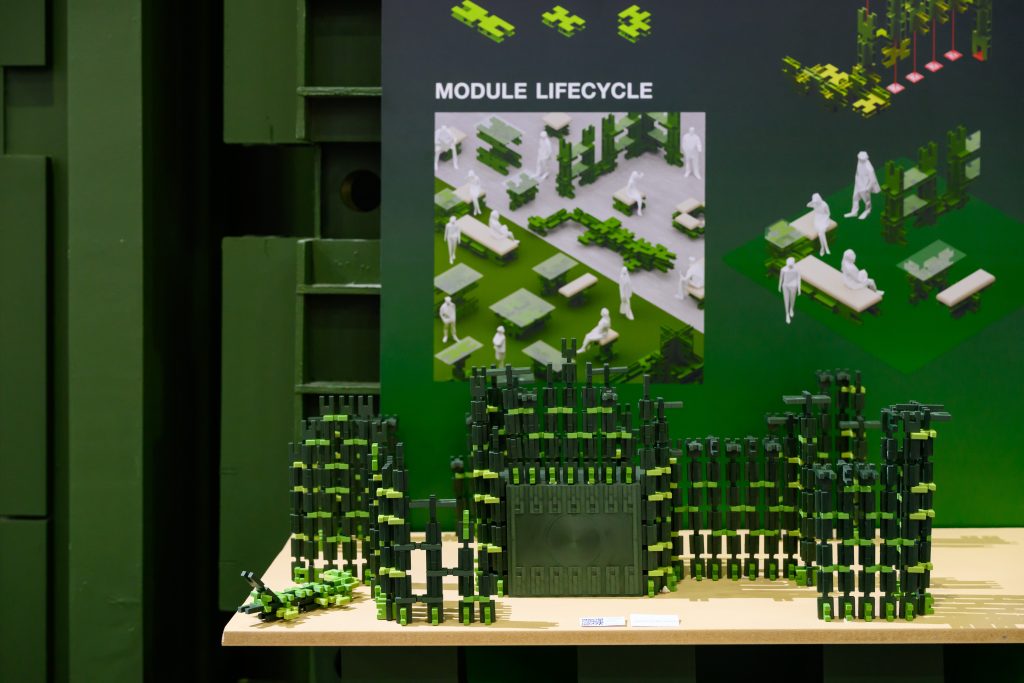
From this brief, the design team developed the pavilion as a Modular Design that could be dismantled, minimizing on-site cutting and reducing damage during dismantling. Every component was considered in advance in terms of how it could be reused after the exhibition.
Dr. Jirat recalls that one of the most impressive aspects of the process was that the IF team did not immediately begin by selecting new materials. Instead, they first visited Jorakay’s factory to explore whether any waste or leftover materials could be repurposed.
When there was not enough waste material available for the pavilion, the team chose pine wood from a plantation forest—a renewable material with a relatively lower environmental impact compared with many other materials.
Beyond the structural materials, the paint used throughout the pavilion was also selected from Jorakay’s Ecological range. Made from natural materials, it is biodegradable and can return to nature, unlike conventional acrylic paint, which can remain as an environmental burden after its useful life.
More Than a Thousand Components, Three Forms, and a Construction System Designed to Minimize Waste
One of the pavilion’s key features was its design of more than 1,000 modular components, based on just three primary forms. These components could be assembled into a large exhibition space while maintaining a clear and recognizable expression of the Jorakay brand.
Importantly, the pavilion was not built using permanent methods such as nailing or permanent welding. Instead, the components were assembled using methods that allowed them to be easily dismantled, minimizing material damage during removal.
To make installation more efficient, the design team also created an assembly manual similar to a LEGO instruction guide, complete with QR Codes providing access to assembly instructions. This made it easier for the installation team to work, reduced the need for on-site cutting and modification, and helped minimize waste throughout the construction process.
The precision of this year’s installation was noticeably different from the conventional image of booth construction. Most of the work involved assembling precisely prepared components, with very little cutting, modification, or on-site correction required.
The result was a faster, cleaner construction process that genuinely reduced waste.
It Wasn’t a Crocodile, but Everyone Knew It Was Jorakay
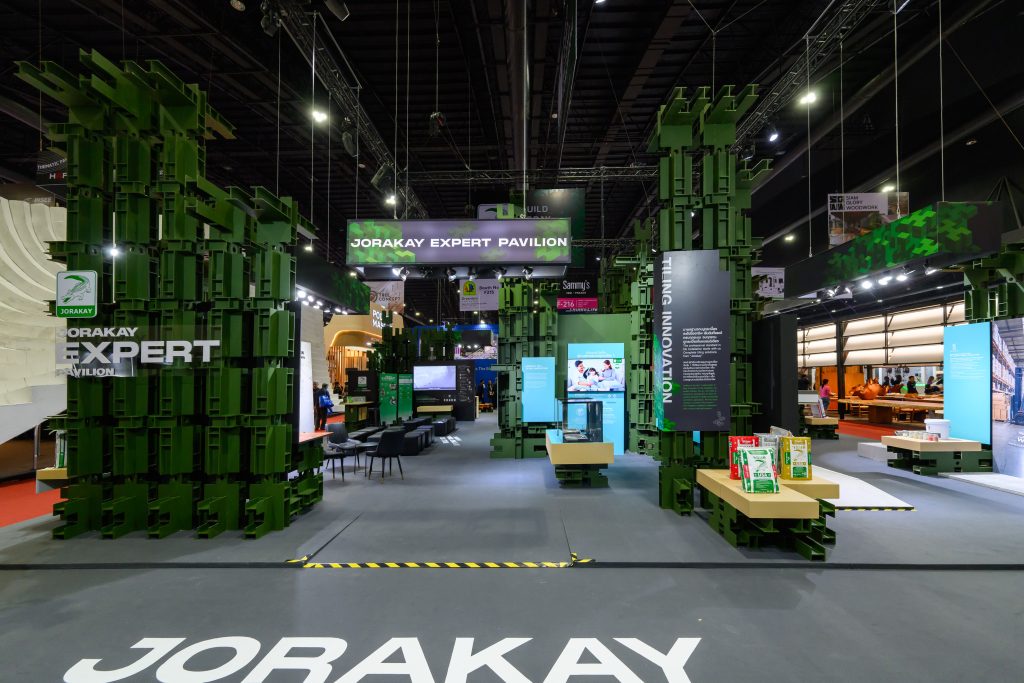
In terms of visual identity, this year’s Jorakay pavilion took a different approach from the brand’s previous exhibitions. Rather than directly using familiar symbols such as a crocodile or crocodile scales, the design team chose to communicate the identity of Jorakay through the image of an expert in construction innovation, under the concept “Build Today Beyond Tomorrow.”
“There was nothing that literally represented a crocodile. No crocodile, no crocodile scales. Yet everyone who came in felt that it was Jorakay.”
This demonstrates the potential of design to communicate a brand without relying on its conventional visual symbols. Instead, the brand identity could be expressed through materials, structures, ways of thinking, and the experience created within the space.
From Pavilion to Furniture for Public Use
After the exhibition, the modular components of Jorakay’s pavilion were not discarded. They were dismantled and transformed into furniture, including tables and other functional pieces, before being passed on for use in public spaces. Jorakay coordinated with the Bangkok Metropolitan Administration (BMA) to ensure that these materials could continue to serve a purpose.
For Jorakay, post-event management is not an end-of-process task to be considered after the exhibition. It is part of the design brief from the very beginning.
If a pavilion is expected to have a second life, the design must begin by considering how each component will be reused, how much material will be lost, and what new value it can create.
This is not something Jorakay has only started doing this year. Dr. Jirat explains that over the years, the company has consistently looked for ways to repurpose booth structures—for example, transforming steel frames into furniture and donating them for further use.
What makes this year different is the use of a modular system that takes the idea further by reducing material damage and waste.
A Sustainable Booth Does Not Have to Cost More When the Brief Is Clear from the Start
When it comes to sustainable booth design, many may assume that it requires a higher budget than a conventional booth. From Jorakay’s perspective, however, the answer is: “Not necessarily.”
Dr. Jirat explains that the budget for this year’s pavilion was at a similar level to the previous year. Compared with some earlier years, it was even more cost-efficient.
The key, therefore, is not necessarily increasing the budget, but establishing a clear brief and working with partners who share the same vision.
When the brand and design team share the goal that a pavilion should minimize waste, be dismantlable, and remain useful after the exhibition, the design process can move in a more creative direction.
“When we find a partner who is genuinely engaged with the brief, the process becomes fun—and the result can continue even after the exhibition ends.”
From Build–Use–Discard to Build–Use–Circulate
For Jorakay, participating in the ASA100 Sustainable Goal initiative is not simply about submitting a pavilion for evaluation. It reinforces an approach the company has been developing continuously: shifting from “build, use, and discard” toward “build, use, and circulate.”
Dr. Jirat believes that if every exhibitor begins with the question of how a pavilion can continue to have a life after the exhibition, Sustainable Exhibition Design can become a reality across all types of booths, regardless of whether the brand is large or small.
“We stop thinking of it as build, use, and discard. Instead, we think about how to build, use, and bring it back into circulation so it can have a longer life.”
He believes the key starting point is not simply telling a designer that the brand wants a booth that demonstrates sustainability or wants to win an award. The brief needs to go further: the pavilion must have a life beyond the exhibition and must not become waste once the event is over.
When the brief changes, the way we approach design changes with it.
And this is the central message that Jorakay’s pavilion at Architect’26 sought to communicate in a tangible way: sustainability does not exist only in products or in statements on promotional signage. It can begin with the very first question asked during the design process.
The question of how a booth can avoid ending its life as waste.
And how it can be designed to continue living, creating value long after the lights of the exhibition have been switched off.
Space reservation for Architect’27 is now open: https://architectexpo.com/th/space-reservation/